|
| Getting water from the Walbran Creek. We prefer to filter our water instead of using pills. Primarily because it tastes better filtered and natural. |
 |
| We thought this ladder was long. Ha! |
 |
| I have my faithful biology teacher to thank for my love of plants. Now, whenever I see fuzzy little plants like these I exclaim, "Oh! How delightful! Look, father, at all the wonderful Lycopodium!" |
 |
| Many wildflowers caught my attention along the way. This indian or labrador tea is actually a species of Rhododendron, R. groenlandicum. |
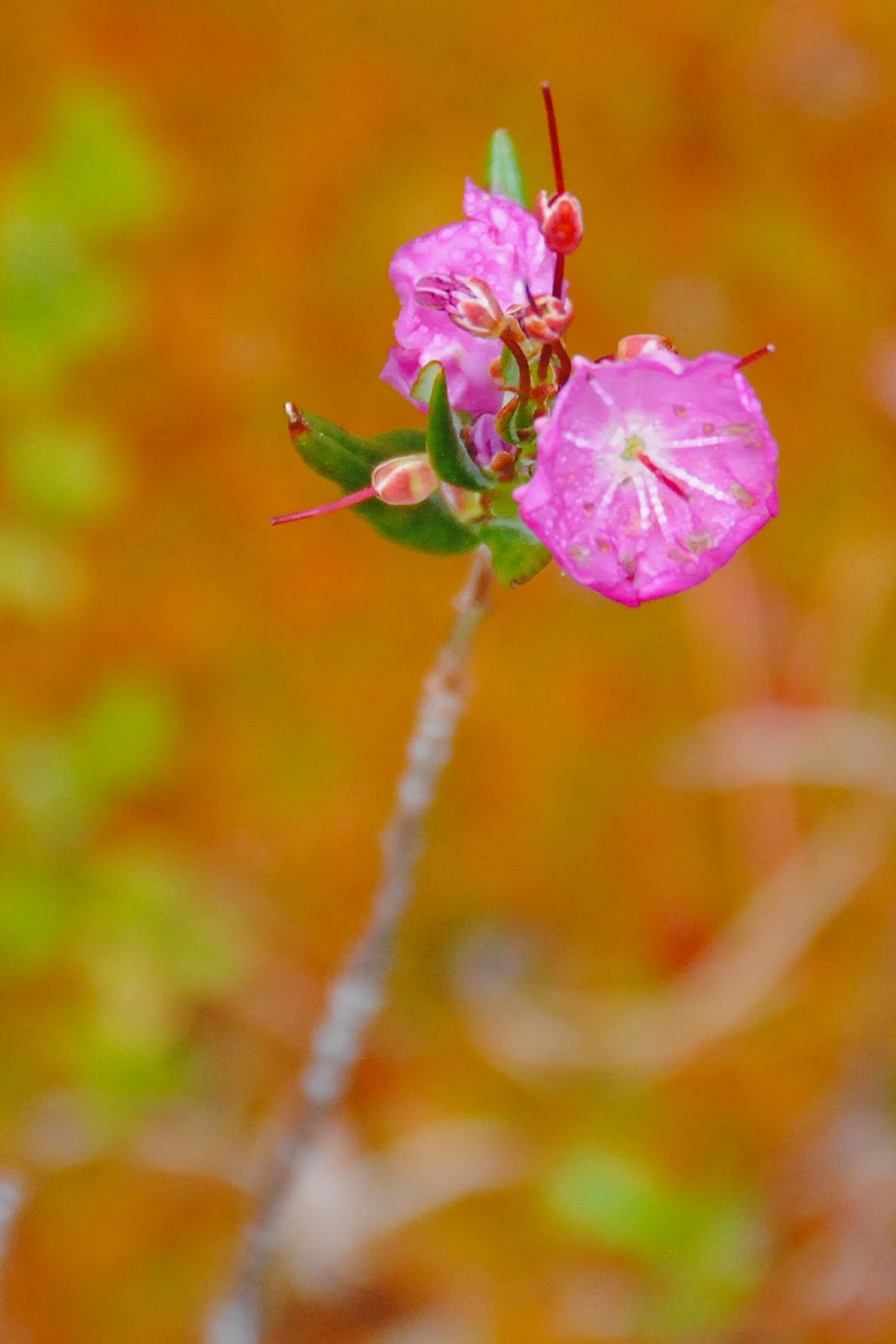 |
| The bog laurel, Kalmia polifolia, is very similar to the Rhododendron growing near by, but is toxic. Not a good idea to confuse the two when out collecting for tea. |
 |
| Drosera rotundifolia. Drosera are among my favourite plants. First, they are carnivorous, snaring unsuspecting insects in the droplets of "dew" on the leaves which quietly fold over to seals the invertebrate's fate. Second, they are down right gorgeous and just saying "Drosera" brings joy to the heart. |
 |
| So we climbed way up this ladder and then back down just to cross a giant bridge to more ladders which go all the way back up before coming back down. |
 |
| The largest bridge of the trip was the Logan Creek bridge. |
 |
| Looks precarious. |


 |
| Our packs seemed especially heavy as gravity attempted to pull us off of this crooked ladder ascending a sheer cliff. |
 |
| The construction team in charge of this one had a good laugh. I'd hate to have to do it without the support. |
 |
| Farther along, roots and mud became more common occurrences. |
 |
| Once again, plant oddities catch my eye. These are liverwort thallus in their gametophyte, non-reproductive stage. |
 |
| Bogs are great places to see interesting plant life. |
 |
| Approaching the campsite at Cullite Creek, a young Steller jay watches us suspiciously. |

 |
| Arriving at Cullite just after noon means we have time to explore. And just as well, because the whole Creek is enclosed by a cliff at each side. It was so secluded and enclosed, yet amazingly beautiful, I felt like I had arrived in paradise. Albeit, a very cold paradise. |
 |
| Harlequin ducks and pigeon guillemots rested on the cliffs and rocks around the cove. |


 |
| The ducks seemed to be feeding on something close to the wall's side. |

 |
| The north side. |
 |
| The boulders of the north wall created a unique landscape of almost maze-like quality. Small fossils, mostly clams and snails, can be seen within many of the crumbling boulders. |


 |
| This male harlequin duck was very frisky. |
 |
| Dad collects some firewood. We were the only ones in the who site; everyone else made five or six nights out of the trial. We did seven. |
 |
| A fallen spruce dwarves my father. |
 |
| A curious fungus coats the bottom of a log. |
 |
| With time to spare, we hiked up Cullite Creek for some distance. There are many salmon fry in the creek. |
 |
| Keen sandals are perfect for these kinds of semiaquatic excursions. |
 |
| Looking back at the temporarily unneeded cable car over Cullite Creek. |
 |
| We do practice no trace camping so no one would ever know we had been there. But it is certainly easy to tell when we are there. As messy as our house. |